
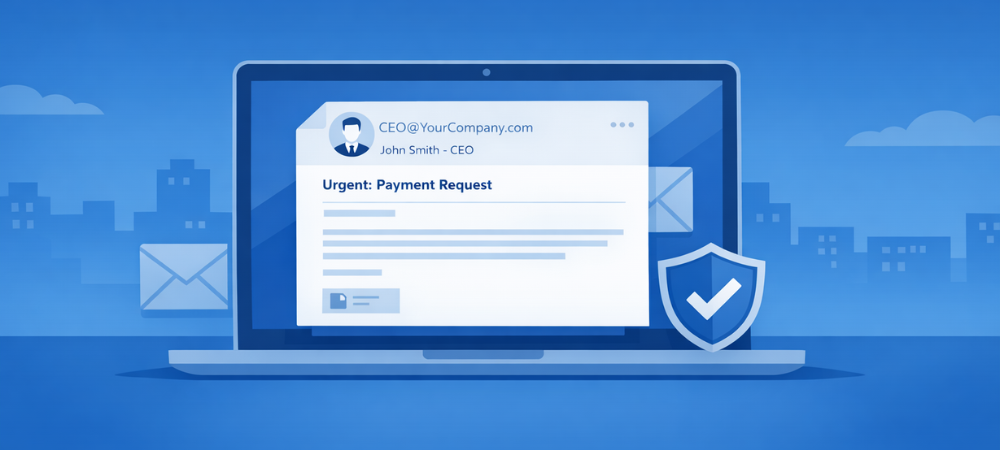
The Most Expensive Email Your Company Will Ever Receive
It looks normal.
It sounds urgent, but not suspicious.
And it often comes from someone you know.
That’s what makes Business Email Compromise (BEC) one of the most expensive and successful cyber scams targeting businesses today.
Unlike flashy ransomware attacks, BEC doesn’t rely on malware or technical wizardry. It relies on trust, timing, and human behavior. And when it works, the damage can be immediate and devastating.
What Is Business Email Compromise?
Business Email Compromise is a form of cyber fraud where an attacker impersonates someone you trust a vendor, executive, finance team member, or business partner to trick you into sending money or sensitive information.
Common BEC scenarios include:
- A “vendor” emailing updated wire instructions
- A “CEO” asking accounting to urgently process a payment
- A fake invoice that looks nearly identical to a real one
- A compromised mailbox quietly monitoring conversations before striking
Because these emails often reference real projects, real people, and real invoices, they don’t raise immediate red flags.
And that’s the problem.
Why BEC Works So Well
BEC attacks are successful because they:
- Don’t look like traditional phishing
- Bypass technical security controls
- Exploit urgency and authority
- Target normal business workflows
Cybercriminals don’t need to break in loudly. They watch. They learn. And then they send one well‑timed email at exactly the wrong moment.
According to the FBI’s Internet Crime Complaint Center (IC3), Business Email Compromise remains one of the most financially damaging cybercrimes year after year, with billions of dollars lost globally. In the FBI’s most recent annual reporting, BEC ranked among the top threats in total financial impact despite fewer overall incidents than phishing or malware attacks. [fbi.gov]
Why Small and Mid‑Sized Businesses Are Prime Targets
There’s a common misconception that BEC only targets large enterprises.
In reality, small and mid‑sized businesses are often easier targets because:
- Payment verification processes are informal
- Staff wear multiple hats
- Security awareness training is limited or inconsistent
- Email security tools may be basic or outdated
Attackers know that one convincing message can move faster than layers of approval.
How BEC Attackers Get Past Email Security
One of the most frustrating things about Business Email Compromise is that the emails often aren’t malicious by technical standards. No infected attachments. No bad links. Nothing for traditional email security tools to automatically block.
Here’s how attackers pull that off.
- They Take Over a Real Email Account
The most effective BEC attacks start with compromised credentials, not fake emails.
Attackers use phishing, password reuse, or exposed credentials to gain access to a legitimate mailbox. Once inside, they:
- Read internal conversations
- Learn payment processes and timing
- Watch who approves invoices or wires
- Respond from the actual email account
Since the email is truly coming from a trusted sender, most email security systems see nothing wrong with it.
- They Use Look‑Alike Domains and Display Names
When account compromise isn’t possible, attackers spoof identities in subtle ways:
- Replacing one letter in a domain name
- Using free domains that look official
- Changing only the display name, not the email address
For example, an email may appear to be from a CEO or vendor at first glance, especially on mobile devices where full email addresses aren’t always visible.
Because the domain is new or technically valid, it may pass basic filtering checks.
- They Avoid Attachments and Links Entirely
Traditional email security focuses heavily on:
- Malicious attachments
- Known bad URLs
- Malware indicators
BEC emails usually contain plain text requests:
“Can you process this today?”
“We updated our wiring details, see below.”
With no malicious payload, there’s nothing for scans to block.
- They Time the Attack Perfectly
BEC attackers don’t rush. They wait for:
- Month‑end or quarter‑end processing
- Executives traveling or unavailable
- Active invoice conversations
By inserting themselves into an existing email thread, the request feels routine, not suspicious. That context helps the email blend in and bypass human and technical scrutiny.
- They Exploit Business Trust, Not Technology
At the end of the day, BEC succeeds because email security can’t judge intent.
If the email:
- Comes from a trusted sender
- Uses correct language and context
- Requests a normal business action
…it often reaches the inbox unchecked. That’s why BEC remains one of the most financially damaging cyber threats despite strong spam filtering and modern security tools.
How Businesses Can Reduce BEC Risk
While no single tool stops every attack, effective protection is layered:
- Advanced email security to detect spoofing and impersonation
- Multi‑factor authentication (MFA) on all email accounts
- Finance and leadership verification procedures for payment changes
- Ongoing user awareness training focused on real‑world scenarios
- Monitoring for compromised accounts and unusual email behavior
Most importantly, security has to support the way your business actually works, not slow it down.
How BEI Helps Protect You From Costly Email Attacks
At BEI, we see Business Email Compromise attempts every day and we know how quickly one email can turn into a major incident.
Our security services are designed to:
- Secure Microsoft 365 and email environments
- Detect impersonation and account compromise
- Strengthen financial and email workflows
- Train employees to spot real‑world BEC attempts
- Respond quickly when something doesn’t look right
BEC attacks are preventable but with the right controls, awareness, and response in place.
Want to reduce the risk of the most expensive email your company might ever receive?
Contact BEI to review your email security and fraud prevention strategy before a threat becomes a loss.

