
The New Insider Threat: Employees Sharing Sensitive Data With AI
AI has quickly become a regular part of the workday. Employees are using tools like Microsoft Copilot, ChatGPT, and other AI assistants to draft emails, summarize documents, brainstorm ideas, and streamline repetitive tasks. The productivity benefits are undeniable, but they also introduce a new cybersecurity concern that many organizations are only beginning to address.
The newest insider threat isn’t necessarily a malicious employee. More often, it’s a well-intentioned team member who unknowingly shares sensitive business information with an AI tool.
How It Happens
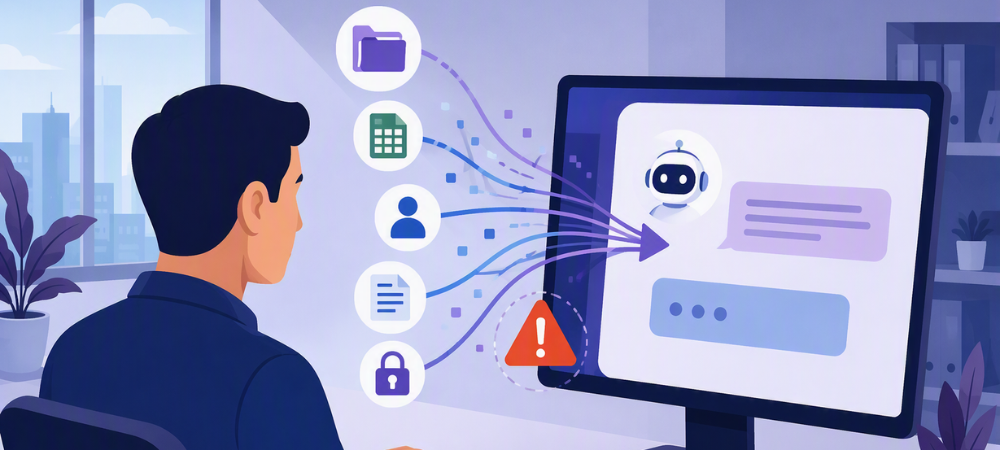
Picture an employee who wants help writing a proposal. To get better results, they copy and paste a client contract into an AI chatbot. Another employee uploads a spreadsheet full of customer data to generate a report summary. A developer pastes company source code into a public AI tool to troubleshoot a problem.
None of these employees are trying to cause harm. They’re simply trying to work more efficiently.
However, depending on the AI platform being used, that information could be stored, processed outside company controls, or exposed to risks that violate internal policies, compliance requirements, or client agreements.
This is what security experts call Shadow AI. It is the use of AI applications without proper organizational oversight.
The Growing Risk
The challenge is that AI adoption is happening faster than many companies can govern it.
According to research from CybSafe and the National Cybersecurity Alliance, 38% of workers admit to sharing sensitive work information with AI tools without their employer’s knowledge. Even more concerning, over half of employees surveyed had not received training on safe AI use.
As AI becomes more embedded into daily workflows, organizations face a growing risk of:
- Client and customer data exposure
- Intellectual property leaks
- Compliance violations
- Unauthorized data sharing
- Loss of visibility into how company information is being used
The reality is that most employees don’t see AI prompts as a security risk. They’re focused on getting answers quickly and that’s exactly what makes this threat so difficult to detect.
Why Traditional Security Controls Aren’t Enough
Traditional cybersecurity tools are designed to protect networks, devices, and email systems. They don’t always provide visibility into what employees are typing into AI platforms.
An employee can unintentionally upload:
- Financial information
- Legal documents
- Employee records
- Internal business strategies
- Customer data
- Proprietary source code
with just a few clicks.
Without clear policies, monitoring, and employee education, organizations can lose control over where sensitive information ends up.
Creating an AI-Safe Workplace
The goal isn’t to stop employees from using AI. In fact, AI can provide tremendous value when used responsibly. Instead, organizations should focus on creating guardrails that allow employees to use AI safely and securely.
A strong AI security strategy should include:
Establish Clear AI Usage Policies
Employees need guidance on what information can and cannot be shared with AI tools.
Provide Employee Training
Security awareness training should now include AI-specific risks and best practices.
Use Approved AI Platforms
Organizations should standardize approved AI tools that offer enterprise-grade security and data protections.
Monitor Data Exposure Risks
Security teams need visibility into how sensitive information is moving throughout the organization.
Review Compliance Requirements
Industries subject to regulations such as HIPAA, PCI, or GDPR should evaluate how AI usage impacts compliance obligations.
For years, insider threats were primarily associated with malicious actors or disgruntled employees. Today, the bigger concern may be well-meaning employees who unknowingly expose sensitive information while trying to work faster with AI.
As AI continues to reshape the workplace, cybersecurity strategies must evolve alongside it. Organizations that strike the right balance between innovation and security will be better positioned to take advantage of AI’s benefits without putting their data at risk.
Is Your Business Ready for AI?
AI can improve productivity, but without the right safeguards, it can also introduce new security and compliance risks.
BEI helps organizations implement secure AI practices, develop governance policies, strengthen cybersecurity controls, and train employees to use AI responsibly. Whether you’re exploring AI tools or already using them across your organization, our team can help you balance innovation with security.
Let’s make sure your data stays protected while your business embraces the benefits of AI. Contact BEI today to learn more about our cybersecurity and AI readiness services.

